The day of Friday, June 12 at Biografilm opens as an invitation to slow down one’s gaze and shift perspective: cinema meets poetry, and for one day the festival becomes a space of widespread listening, where images do not merely tell stories but become an opportunity for writing, crossing thresholds, and questioning reality itself. Thus, Biografilm Poesia – The Life That Writes is born, curated by Emanuela Ceddia and Franca Mancinelli: a new section that introduces a different language into the festival—fragile and powerful—capable of standing alongside visual storytelling with the voice of poetic language.
Opening this new journey is the presence of Milo De Angelis, one of the most important contemporary Italian poets, a voice that for decades has been exploring the relationship between life and writing, destiny and language. His work, from Somiglianze to Linea intera, linea spezzata, spans generations of readers and stands as one of the most radical explorations of poetic language in our time. His participation marks the festival’s entry into a different dimension, where poetry does not accompany reality but passes through it.
The first event takes place at 4:00 p.m. at Sympò with “Dialogues from the Residency. Round Table on Poetic Language and Vision.” Here poetry takes shape as a shared experience: four young authors—Tommaso Di Dio, Andrea Donaera, Elena Lacentra, and Giada Borgagni—have experienced the festival as a period of immersion, moving through screenings and transforming them into material for writing. Not commentary, not translation, but a kind of poetic ecosystem born from direct contact with cinema. Around them, critics, scholars, and cultural practitioners including Maria Borio, Riccardo Donati, Marco Pelliccioli, Stefano Raimondi, Lidia Riviello, and Mara Travella engage in a dialogue between vision, thought, and language.
The day then moves, at 8:30 p.m., to the Cloister of the Santa Cristina “della Fondazza” Complex, where the event “I Will Search for Words That Save You” takes place: Milo De Angelis in conversation with Emanuela Ceddia and Franca Mancinelli, accompanied by readings by Viviana Nicodemo, who brings the living voice of poetry to the stage. It is an intimate and suspended moment, where language once again becomes presence, relation, and an attempt at shared salvation.
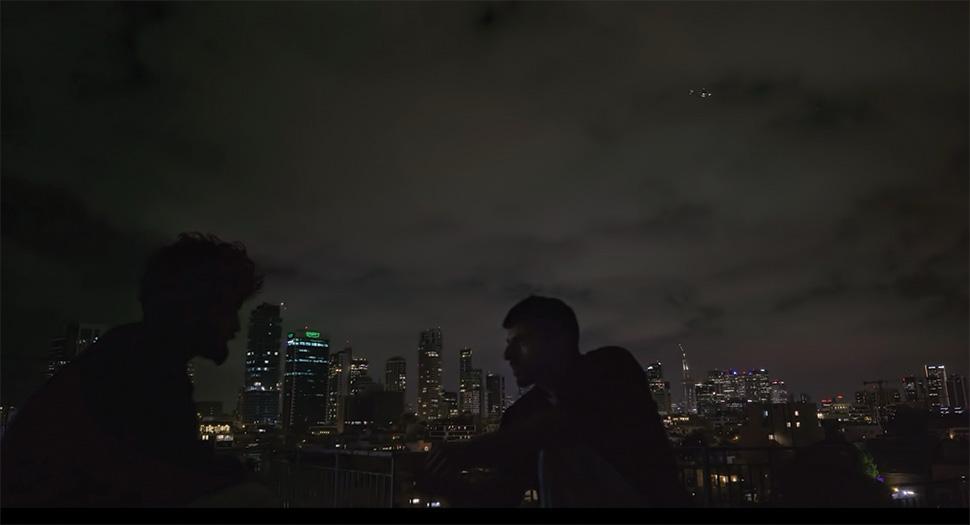
Immediately after, at 9:30 p.m., the cloister opens to cinema with the screening of The Desert of the Real by Luuk Bouwman, introduced by the project curators. Here, the passage between poetry and cinema becomes natural, almost inevitable: two different ways of questioning reality that respond to each other across distance. From 7:30 p.m., the space is already animated by a wine tasting curated by FIVI – Italian Federation of Independent Winegrowers, turning the cloister into a place of encounter and passage even before the screening begins.
Alongside the poetic core of the day, the festival continues to unfold through a broad and international cinematic program. At 4:15 p.m. at Cinema Lumière – Scorsese Hall, in collaboration with Goethe Zentrum, bauhaus forever. by Nico Weber brings the viewer into the echo of an unfinished modernity, questioning what remains of an idea when its material forms fade and only its original tension survives.
At 6:00 p.m. at BIOGRAFILM HERA THEATRE | Pop Up Cinema Arlecchino, the documentary series Sguardi in camera by Francesco Corsi and Paolo Simoni, narrated by Milena Vukotic, explores Italian memory through amateur footage and fragments of everyday life, revealing cinema’s most fragile and human side. The directors will be present in the auditorium.
At 7:00 p.m., the program returns to Cinema Lumière with Los que saben by Simona Bua and Jesús González Mariscal, set in the mountains of southern Mexico, where healer Doña Paulina preserves ancient knowledge now in dialogue—and at times in tension—with Western medicine. It is a film about care, but also cultural resistance and the future of knowledge systems.
At 8:30 p.m. at BIOGRAFILM HERA THEATRE | Pop Up Cinema Arlecchino comes American Doctor by Poh Si Teng, following three doctors of different religious and cultural backgrounds between Gaza and the United States. A story that crosses political and moral borders, placing individual responsibility at the center of war and humanitarian crisis.
The day closes at 9:00 p.m. at Cinema Lumière – Scorsese Hall with Lo spazio vuoto by Stefano P. Testa and Alberto Ceresoli, a film born from loss and attempting to reconstruct it through the perspective of a son. The voices of others become traces, clues, attempts to understand what remains when a life ends too soon. The directors and producers Nadia Ghisalberti (Perseo Film) and Giorgia Goi (Lab 80) will be present.
It is a day that moves across different registers yet remains deeply interconnected: poetry opening breaches in language, cinema gathering stories and memory, images becoming tools to interrogate the present. Biografilm continues to build a space where forms of storytelling multiply, contaminate one another, and listen to each other—offering the audience not only films and words, but new ways of inhabiting the world.