16 April 2026
A look beyond the threshold: the image of the 22nd edition interprets documentary cinema as a space for critical and plural vision on the complexity of reality.
Accreditation campaign now open. Stories worth telling take center stage once again across all sections of Biografilm, the film festival set to take place in Bologna from June 5 to 15, under the artistic direction of Chiara Liberti and Massimo Benvegnù. The first six titles and the visual identity of the 22nd edition have been unveiled. The passion for storytelling returns with the first films in the Biografilm 2026 lineup. From Armenia to Denmark, via Hungary, Italy, and the United Kingdom, these films offer perspectives on the world through their protagonists, exploring politics, history, religion, and utopia.
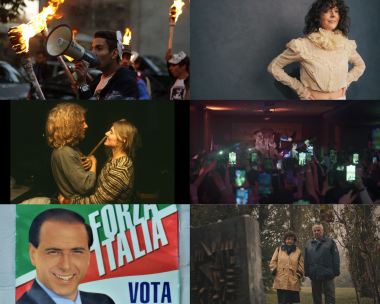
In the International Competition, The Winning Generation by Marco De Stefanis, a co-production between the Netherlands, Italy, and Armenia, is a documentary filmed over the course of 12 years, following Shahen Harutyunyan from a fourteen-year-old activist to an emerging political leader. Carrying forward the legacy of his father and grandfather in the long struggle for Armenia’s independence, Shahen transforms their tradition of resistance into a new democratic vision. As Armenia faces political instability and strong Russian influence, he seeks to forge his own path while redefining what the fight for freedom might look like for a new generation. A story that is at once personal, familial, and collective.
Within the Biografilm Italia Competition, Everything Works Out (In the End) by Maximilien Dejoie, also a co-production between Italy and the United Kingdom, tells the incredible true, road-movie-style story of a former strip dancer and the wife of a rock star. After a tumultuous life marked by fame and tragedy, Katelyn turns to faith and embarks on a car journey across a divided America. Her search for balance between her relationship with God and her life is far from easy. Katelyn’s journey stands as a testament to the power of personal emancipation, set against the contradictions of contemporary American society.
In the section dedicated to auteur perspectives on contemporary life, Contemporary Lives, the Italian premiere of Christiania by Karl Friis Forchhammer will be presented. This unconventional and entertaining Danish documentary retraces the history of one of the world’s boldest social experiments, part of Denmark’s history as well as the director’s personal story: 50 years of grand dreams, anarchist ideals, consensus democracy, street artists, and countless eccentric anecdotes.
In the Art & Music section, premiering in Italy from Hungary, Meant to Be by Olivér Márk Tóth captures both a rising icon and the spirit of Generation Z. A teenager from a small Hungarian town with an extraordinarily deep voice becomes, at just 18, a rap star and one of the most beloved figures in the Hungarian hip-hop scene. He began writing lyrics at the age of ten, and his unique talent has taken him from his favorite skateparks to the top of the music charts. As Pogany—stage name of Marci—rises to fame, balancing school, family, and music proves impossible.
Among the Special Events, in its Italian premiere, The Revolution Will Be Televised - The Men Who Made Berlusconi by Fabio Lucchini shows how entertainment, advertising, and the concentration of media ownership paved the way for a new political era in Europe. Produced in France, the film features testimonies from Giancarlo Galan, Carlo Freccero, and Carlo Momigliano—young, dynamic executives who found themselves at the heart of the Berlusconi machine. The men who brought “Baywatch” and “The Simpsons” to Italian television were the first to apply TV marketing strategies to politics, creating a new form of populism. Their ideas shaped public debate and polarized societies worldwide.
In the same section, In gran segreto – A Family Story about Giorgio Bassani, a documentary by Toni Trupia, portrays a central figure of twentieth-century Italian culture. Writer Giorgio Bassani recounted Italian history from the 1930s onward, highlighting its contradictions and wounds, while personally experiencing the conflicts he described. Marking the 110th anniversary of his birth, the film brings together his children, Paola and Enrico, along with family members, writers, scholars, friends, and students, including Paolo di Paolo, Eraldo Affinati, Nadia Terranova, Fulco Pratesi, and Gabriele Lavia.